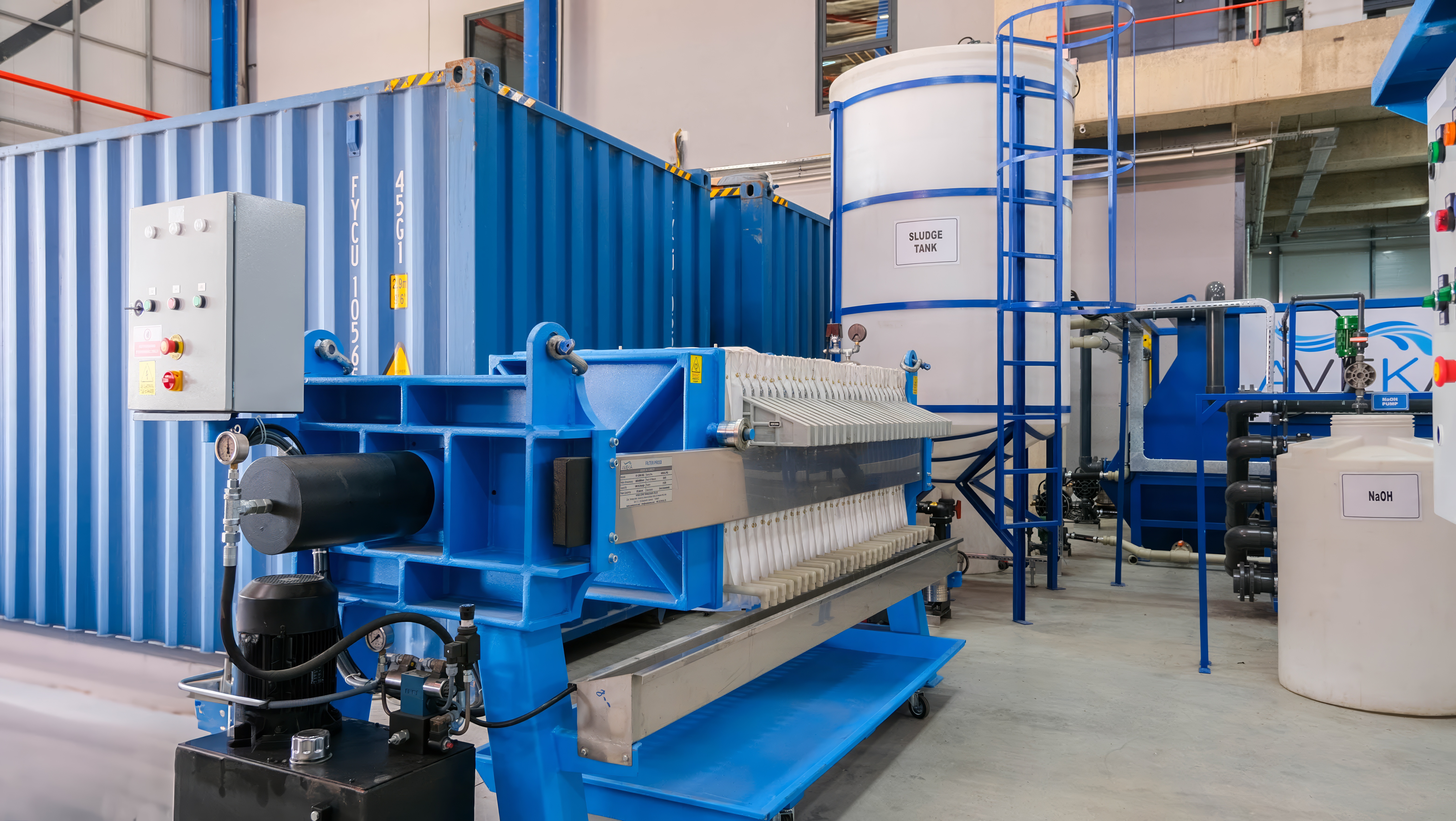
Dewatering and drying of waste sludge is not only a legal requirement but also provides significant operational benefits:
• Reduces transportation costs to final disposal sites
• Requires less energy for drying after dewatering
• Increases the calorific value of sludge prior to incineration
• Reduces the amount of bulking material required before composting
• Minimizes excess moisture to support effective odor control
• Decreases leachate formation at landfill sites
Filter presses are one of the primary pieces of equipment used for sludge dewatering and various filtration processes. Operating principle is based on the pressurising of the sludge between filter plates, while the liquid phase passes through filter cloths and is discharged from the system.
Depending on user requirements, filter presses are available in manual, semi-automatic, fully automatic, and heated drying models. Due to low investment and operating costs, ease of operation, and high performance, filter presses offer a broad range of applications.
Sludge generated in wastewater treatment plants is dewatered using a filter press. This significantly facilitates sludge storage, transportation, and disposal while considerably reducing associated costs.
Large volumes of water are used in concrete batching plants for vehicle and site washing operations. This wastewater can be filtered and recovered for reuse within the facility. Another key advantage is its ability to dewater sludge containing aggregates and cement particles present in the water.
Filter presses are used for filtration in the production processes of various chemical compounds such as sodium bisulfite, zinc sulfate, copper sulfate, and zinc oxide.
In the filtration of cold-pressed vegetable oils, filter presses are used to achieve a clear and sediment-free product. In biodiesel production, they ensure the removal of impurities from the oil, improving overall product quality.
Lime sludge formed as a result of carbide neutralization is dewatered using a filter press. The resulting solid waste is safely stored and transported to disposal sites without environmental contamination.
Slurry generated during mining operations is first settled in a decanter, then dewatered using a filter press. The recovered water can be reused in the process, while the dewatered sludge is stored in a more stable solid form.
Filtration of metal plating baths, recovery of precious metals from gypsum blasting wastewater in the jewelry sector, recovery of valuable metals from polishing and buffing residues are common usage of filter press.
Filtration of marble cutting wastewater, dewatering of slurry in ceramic and bentonite production, achieving the required consistency for shaping and processing are common usage of filter press.
Merhaba! Size nasıl yardımcı olabiliriz?
WhatsApp ile Bağlan